
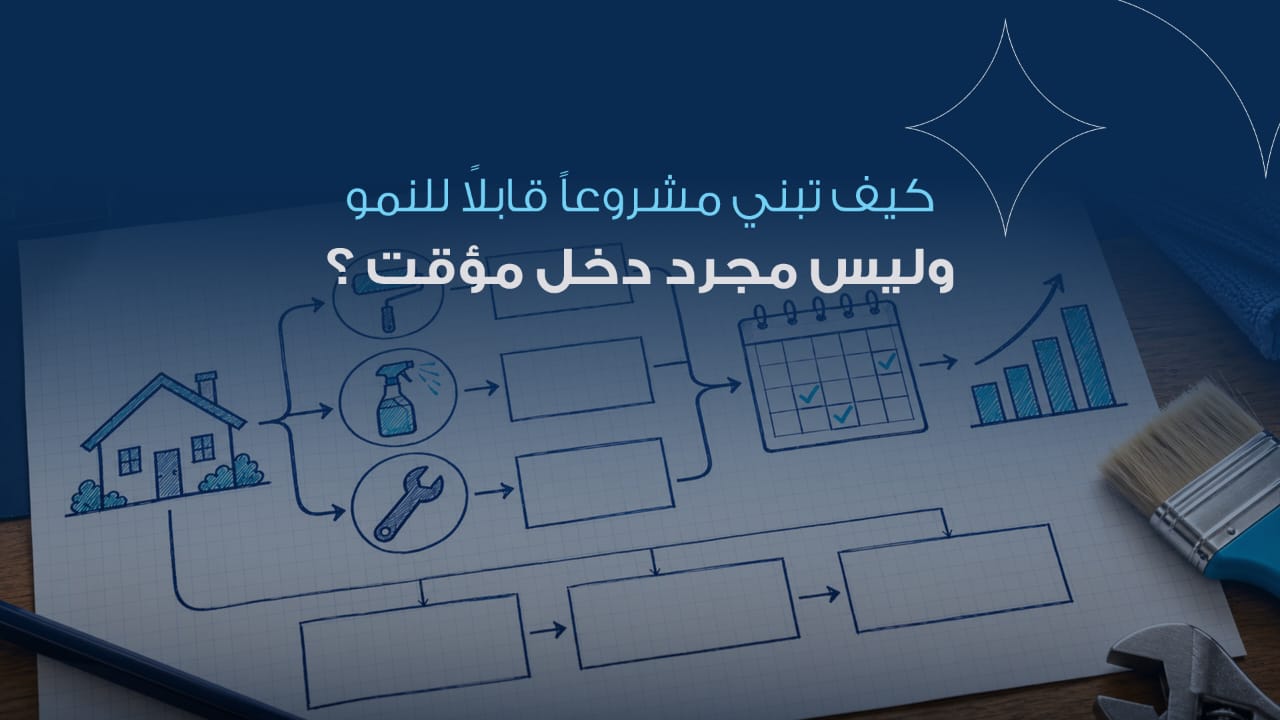
Where Ideas Begin
In a time when opportunities are more accessible than ever, it has become remarkably easy for anyone to start a small project that generates quick income. A simple idea, a limited service, or a personal skill may seem enough to launch a venture that brings in money and gives its owner a sense of achievement. Yet, no matter how promising these projects appear at the beginning, they often fade at the first crisis, the first competitor, or the first shift in the market. The issue is not the idea itself, but the nature of the project: it was never built to be a scalable entity—it was built to be a temporary source of income.
The Difference Between Income and a Real Business
There is a fundamental difference between a project that survives for a year or two and one that lasts ten years, grows, expands, and becomes a recognized name in the market. This difference does not lie in the amount of effort, the strength of marketing, or the number of clients. It lies in the methodology on which the project was built. Projects created as temporary income depend on circumstances, while projects designed to be scalable rely on structure, on systems, on vision, and on the ability to transform enthusiasm into an independent operational framework.
A Business That Depends on Its Owner Is Not a Business
A project that relies entirely on its owner is not a business—it is an additional job, no matter how profitable it may seem. If the owner is absent, the project stops. If the owner is exhausted, the project collapses. If the owner becomes busy, the project declines. And if the owner tries to expand, the project suffocates.
This type of project cannot grow because it lacks a system that clarifies its steps and a stable identity that assures clients of what they will receive each time. A real business is one that continues to operate even when its owner is not present—because it is built on a system, not on a person.
Growth Is Not a Coincidence
Real growth does not happen by chance. It does not occur simply because the owner works hard, or because marketing is strong, or because circumstances are favorable. Growth happens when the project is intentionally designed to be scalable from the very beginning—when its services are built to be repeatable, its identity crafted to be expandable, and its operations structured to function even in the absence of its founder. Growth is the result of conscious design, not temporary activity.
The Market’s Test
The market does not forgive temporary projects—it tests them every single day. It tests their ability to deliver consistent quality regardless of staff changes. It tests their ability to handle increased demand without collapsing. It tests their ability to maintain identity despite competition. It tests their ability to operate as a company, not just a small service provider.
The market rewards businesses built to last, not those built to profit today. It rewards businesses that respect themselves, not those that chase every client. It rewards businesses that know their value, not those afraid to raise their prices.
Growth Begins from Within
Many believe growth comes from marketing, from increasing clients, or from expanding services. But the truth is that growth begins from within. It begins with the system, with the workflow, with team culture, with service quality, with clarity of responsibilities, with repeatability, and with the ability to deliver the same experience to every client regardless of who performs the work.
A project without a clear internal system cannot grow, no matter how strong its marketing is. A project with a strong internal system grows—even with simple marketing.
Hosa Wa Nos as a Model
When Hosa Wa Nos was founded, it was not built to be a small project dependent on circumstances. It was built to be a company capable of growth, expansion, premium service delivery, and long-term relationships with clients who seek quality rather than price.
The company chose the difficult path: The path of building systems instead of working randomly. The path of consistent quality instead of quick fixes. The path of a professional team instead of relying on one person. The path of long-term vision instead of short-term profit.
This is what made it a company with strong market positioning, premium pricing, and a value that clients can feel in every experience.
A Business That Respects Itself
A scalable business is one that respects itself before the market respects it. It respects its time, its quality, its team, its clients, its identity, its value, and its future.
A scalable business does not offer cheap service, does not operate chaotically, does not change its approach every day, and does not fear competition. A scalable business knows its worth—and makes the market know it too.
In the end, projects built as temporary income disappear, while projects built as real companies endure. Growth is not the result of luck, nor of hard work, nor of favorable circumstances. Growth is the result of design, of systems, of vision, of quality, of team strength, and of identity.
This is the path Hosa Wa Nos chose from its very first day: To be a scalable business, not just a source of income. To be a company built to grow, not to survive the moment. To be a market name, not just a label.
